
Cognitivism
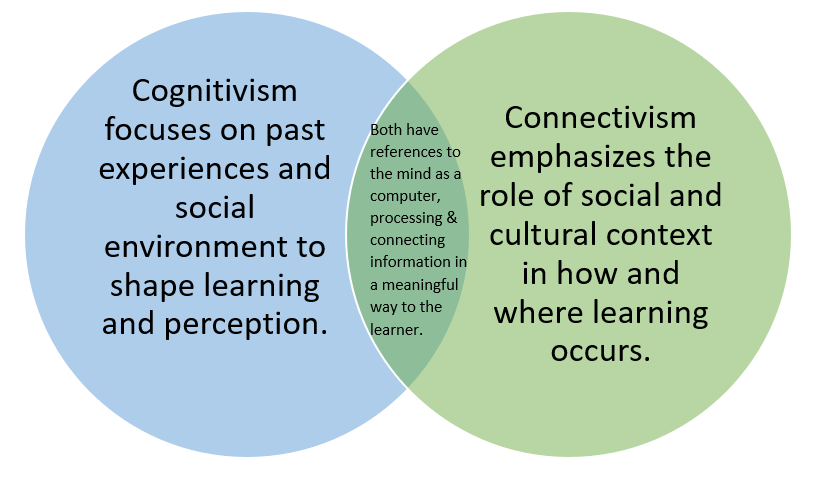
Cognitive theory mainly stresses the acquisition of knowledge and growth of the mental structure. Cognitive theory tends to focus on conceptualizing the student’s learning process: how information is received; how information is processed and organized into existing schema; how information is retrieved upon recall. In other words, cognitive theory seeks to explain the process of knowledge acquisition and the subsequent effects on the mental structures within the mind. Learning is not about the mechanics of what a learner does, but rather a process depending on what the learner already knows (existing information) and their method of acquiring new knowledge (how they integrate new information into their existing schemas). Knowledge acquisition is an activity consisting of internal codification of mental structures within the student’s mind. Inherent to the theory, the student must be an active participant in their own learning process. Cognitive approaches mainly focus on the mental activities of the learner like mental planning, goal setting, and organizational strategies (Shell, 1980). In cognitive theories not only the environmental factors and instructional components play an important role in learning. There are additional key elements like learning to code, transform, rehearse, and store and retrieve the information. Learning process includes learner’s thoughts, beliefs, and attitude values (Winna, 1988).
Connectivism
Connectivism is a theory of learning in a digital age that emphasizes the role of social and cultural context in how and where learning occurs. Learning does not simply happen within an individual, but within and across the networks. What sets connectivism apart from theories such as constructivism is the view that “learning (defined as actionable knowledge) can reside outside of ourselves (within an organization or a database), is focused on connecting specialized information sets, and the connections that enable us to learn more are more important than our current state of knowing”.[1] Connectivism sees knowledge as a network and learning as a process of pattern recognition.[2] Connectivism has similarities with Vygotsky’s ‘zone of proximal development‘ (ZPD) and Engeström’s Activity theory.[3] The phrase “a learning theory for the digital age”[4] indicates the emphasis that connectivism gives to technology’s effect on how people live, communicate, and learn.
Cognitivism vs. Connectivism
The graphic below explains both Cognitivism and Connectivism and how they are related.
Four key themes emerge out of the work around The Process of Education (1960: 11-16):
The role of structure in learning and how it may be made central in teaching. The approach taken should be a practical one. ‘The teaching and learning of structure, rather than simply the mastery of facts and techniques, is at the center of the classic problem of transfer… If earlier learning is to render later learning easier, it must do so by providing a general picture in terms of which the relations between things encountered earlier and later are made as clear as possible’ (ibid.: 12).
Readiness for learning. Here the argument is that schools have wasted a great deal of people’s time by postponing the teaching of important areas because they are deemed ‘too difficult’.
We begin with the hypothesis that any subject can be taught effectively in some intellectually honest form to any child at any stage of development. (ibid.: 33)
This notion underpins the idea of the spiral curriculum – ‘A curriculum as it develops should revisit these basic ideas repeatedly, building upon them until the student has grasped the full formal apparatus that goes with them’ (ibid.: 13).
Intuitive and analytical thinking. Intuition (‘the intellectual technique of arriving and plausible but tentative formulations without going through the analytical steps by which such formulations would be found to be valid or invalid conclusions’ ibid.: 13) is a much neglected but essential feature of productive thinking. Here Bruner notes how experts in different fields appear ‘to leap intuitively into a decision or to a solution to a problem’ (ibid.: 62) – a phenomenon that Donald Schön was to explore some years later – and looked to how teachers and schools might create the conditions for intuition to flourish.
Motives for learning. ‘Ideally’, Jerome Bruner writes, interest in the material to be learned is the best stimulus to learning, rather than such external goals as grades or later competitive advantage’ (ibid.: 14). In an age of increasing spectatorship, ‘motives for learning must be kept from going passive… they must be based as much as possible upon the arousal of interest in what there is be learned, and they must be kept broad and diverse in expression’ (ibid.: 80).
He makes the case for education as a knowledge-getting process:
To instruct someone… is not a matter of getting him to commit results to mind. Rather, it is to teach him to participate in the process that makes possible the establishment of knowledge. We teach a subject not to produce little living libraries on that subject, but rather to get a student to think mathematically for himself, to consider matters as an historian does, to take part in the process of knowledge-getting. Knowing is a process not a product. (1966: 72)
Social Cognitivism
Albert Bandura’s social cognitive theory combines an interest in cognition with recognition of the way learning is not purely a solitary, internal matter but rather takes place interpersonally. Begin with a short overview of social cognitive theory.
- Bandura argued that much learning comes through observation and imitation, but psychological concepts like agency also play a key role.
- Agency is the sense that you are a do-er, not just a static thing. The idea of agency implies that you are constantly monitoring and adjusting your behavior based on outcomes, and that you have some sense of mastery over what you do and what the results are.
- Bandura argued that one key pre-condition for learning is self-efficacy: your belief you are able to do so or capable of doing something.
- Self-efficacy can be increased by various means, but significant experiences of mastery are particularly important. This means you didn’t just master something trivial: you mastered something challenging–usually supported by others.
- The concept of self-efficacy is also a bridge between learning theory and theories of behavior change used in psychotherapy and counseling.
In social learning theory, Albert Bandura (1977) agrees with the behaviorist learning theories of classical conditioning and operant conditioning. However, he adds two important ideas:
- Mediating processes occur between stimuli & responses.
- Behavior is learned from the environment through the process of observational learning.
Observational Learning
Children observe the people around them behaving in various ways. This is illustrated during the famous Bobo doll experiment (Bandura, 1961).
Individuals that are observed are called models. In society, children are surrounded by many influential models, such as parents within the family, characters on children’s TV, friends within their peer group and teachers at school. These models provide examples of behavior to observe and imitate, e.g., masculine and feminine, pro and anti-social, etc.
Children pay attention to some of these people (models) and encode their behavior. At a later time, they may imitate (i.e., copy) the behavior they have observed. They may do this regardless of whether the behavior is ‘gender appropriate’ or not, but there are a number of processes that make it more likely that a child will reproduce the behavior that its society deems appropriate for its gender.
First, the child is more likely to attend to and imitate those people it perceives as similar to itself. Consequently, it is more likely to imitate behavior modeled by people of the same gender.
Second, the people around the child will respond to the behavior it imitates with either reinforcement or punishment. If a child imitates a model’s behavior and the consequences are rewarding, the child is likely to continue performing the behavior. If a parent sees a little girl consoling her teddy bear and says “what a kind girl you are,” this is rewarding for the child and makes it more likely that she will repeat the behavior. Her behavior has been reinforced (i.e., strengthened).
Reinforcement can be external or internal and can be positive or negative. If a child wants approval from parents or peers, this approval is an external reinforcement, but feeling happy about being approved of is an internal reinforcement. A child will behave in a way which it believes will earn approval because it desires approval.
Positive (or negative) reinforcement will have little impact if the reinforcement offered externally does not match with an individual’s needs. Reinforcement can be positive or negative, but the important factor is that it will usually lead to a change in a person’s behavior.
Cognitive Load
Cognitive Load Theory was developed by John Sweller. He published a paper on the subject in the journal Cognitive Science in 1988.
“Cognitive load” relates to the amount of information that working memory can hold at one time. Sweller said that, since working memory has a limited capacity, instructional methods should avoid overloading it with additional activities that don’t directly contribute to learning.
Cognitive Load Theory proposes that the human mind can only focus on or hold a limited amount of the information at once; thus, it’s extremely important as an instructional designer to eliminate extraneous elements (on a page, in a presentation or recording, in a PDF document).
Cognitive Load Theory also shows us that working memory can be extended in two ways. First, the mind processes visual and auditory information separately. Auditory items in working memory do not compete with visual items in the same way that two visual items, for example a picture and some text, compete with one another.
This is known as the “Modality Effect.” So, for example, explanatory information has less impact on working memory if it is narrated, rather than added to an already complex diagram.
Second, working memory treats an established schema as a single item, and a highly practiced “automated” schema barely counts at all. So, learning activities that draw upon your existing knowledge expand the capacity of your working memory.
This means that pre-training, or teaching people prerequisite skills before introducing a more complex topic, will help them establish schemas that extend their working memory; and this then means that they can understand and learn more difficult information.
Key Points
Cognitive Load Theory (CLT) is an instructional design theory that reflects our “cognitive architecture,” or the way that we process information.
During learning, information must be held in your working memory until it has been processed sufficiently to pass into your long-term memory. Your working memory’s capacity is very limited. When too much information is presented at once, it becomes overwhelmed and much of that information is lost.
CLT makes learning more efficient by using training methods that reflect this.
These methods include:
- Measuring expertise and adapting your instruction accordingly.
- Reducing the problem space by breaking problems down into parts, and by using partially completed problems and worked examples.
- Merging together multiple sources of visual information whenever possible.
- Extending the capacity of working memory by using both visual and auditory channels.
CLT proposes that there are three types of cognitive load:
- This is the level of complexity inherent in the material being studied. There isn’t much that we can do about intrinsic cognitive load; some tasks are more complex than others so will have different levels of intrinsic cognitive load.
- This is cognitive load imposed by non-relevant elements that require extra mental processing e.g. decorative pictures, animations etc. that add nothing to the learning experience.
- These are elements that allow cognitive resources to be put towards learning i.e. assist with information processing.
The three types of cognitive load are additive so according to the theory, for instruction to be effective:
Intrinsic load + Extraneous load + Germane load < Working memory capacity
To assist learners in transferring information from their working memory to their long-term memory, we need to present the information in such a way that it reduces extraneous cognitive load (non-relevant items) and, if possible, increases germane cognitive load (items that assist with information processing). Note: I’ve found that much of the literature tends to focus on reducing extraneous cognitive load.Mayer and Moreno (2003) conducted research into ways to reduce cognitive load in multimedia learning. Their research, built on CLT, was based on three assumptions:
- Humans possess separate information processing channels for verbal and visual material (Dual Channel).
- There is only a limited amount of processing capacity available via the visual (eyes) and verbal (ears) channels (Limited Capacity).
- Learning requires substantial cognitive processing via the visual and verbal channels (Active Processing).
5 ways to reduce cognitive load in e-Learning based on the findings of Mayer and Moreno
- Present some information via the visual channel and some via the verbal channel
If all of the content is processed visually i.e. via text, pictures or animations, the visual channel can become overloaded. Using narration transfers some of the content to the verbal channel thereby spreading the load between the channels and improving processing capacity.
- Break content into smaller segments and allow the learner to control the pace
If the content is complex and the pace is too fast, the learner may not have enough time to effectively process the information. Breaking complex content into smaller chunks and allowing the learner to control the speed of the learning lets them to process the information more effectively.
- Remove non-essential content
Background music and decorative graphics may appear to make the e-Learning more interesting. However, these elements require incidental processing and increase extraneous load. If the content doesn’t support the instructional goal, it should be removed.
- Words should be placed close as possible to the corresponding graphics
When text is located away from the corresponding graphic, learners are forced to scan the screen in order to align the text to the graphic which requires additional cognitive processing. Placing the text close to the corresponding graphic improves the transfer of information.
- Don’t narrate on-screen text word-for-word
When on-screen text is narrated, the same information is presented to learners via both channels. Rather than spreading the load, learners are forced to process the same information twice which means that there is a great deal of redundancy. If using narration, the on-screen text should be a summary.
As instructional designers, we need to be aware of the cognitive requirements our designs impose and ensure that our learners can meet those requirements. We must also ensure that all aspects of our design focus on adding value to the learning experience.
How to Reduce Cognitive Overload in e-Learning
Cognitive overload stems from the Cognitive Load Theory, which is attributed to John Sweller, an Australian educational psychologist. It suggests that the human mind can only absorb and retain a limited amount of information. If this limit is exceeded, you run the risk of overloading their mental pathways. It pertains to short-term or working memory, given that this area of our brain, according to Miller’s “7 plus or minus 2 Rule” [1], can only process and store 5 to 9 pieces of information at once. When there is too much data flowing simultaneously, or we aren’t given enough time to process information, it simply overflows and never makes it to the long-term memory banks. The good news is that there are ways that you can prevent cognitive overload when designing your next e-Learning course.
- Use e-Learning Assessments to Determine Preexisting Knowledge
If your online learners already possess the knowledge, they won’t need to learn it again. Likewise, they can use that preexisting knowledge to form a connection with new information. For example, if a learner already possesses basic customer service skills, you can build upon that base and explore a more complex process, such as completing a return or placing a special order. They have the mental schema that is necessary and you simply need to access it in order to expand their comprehension. Conduct surveys, task analysis, skills assessments, and focus groups to gauge their current knowledge base and skill proficiency.
- Divide Complex Problems into Smaller Steps
Complicated processes are one the main culprits when it comes to cognitive overload. This is primarily because there are so many steps, skills, and sub-tasks involved. As such, it’s essential to break them down into more manageable parts that they can master one at a time. The same principle applies to complex problems or concepts. By dividing them into smaller, bite-sized ideas and subtopics you give online learners the opportunity to absorb and retain the information before moving to the next module.
- Opt for a Clean, Chaos-Free e-Learning Design
Many people naturally associate cognitive overload with text-based e-Learning content. However, the visual aspects of your e-Learning course design also play a major role. It’s best to keep your layout clutter free and organized in order to direct their attention to the key takeaways. Don’t be afraid to include white space, and only include images that relate to the subject matter and support your objectives. Keep busy backgrounds to a minimum and choose audio that enhances the ambiance instead of distracting your online learners. In addition, opt for colors that set the right tone and create a sense of harmony instead of bold hues that overpower the e-Learning course design.
- Pair Text with Visuals and Audio
While too much of a good thing can hinder the e-Learning experience, it is advisable to pair your text with images and audio in order to boost knowledge retention. This is especially true if you want to emphasize an important concept or idea, given that the human mind assimilates information more effectively when it’s in a visual format. Just make certain that your e-Learning course isn’t too repetitive or redundant, as online learners will have to process the information all over again instead of devoting that working memory space to new concepts.
- Give Their Memory Banks a Break
There are times when the human mind needs a breather. This is why it’s vital to offer your online learner’s a break every now and then, and give their memory banks a chance to catch up. Space your learning activities so that they have time to reflect and assimilate the information. You can also ease the strain on their memory by substituting lengthy text blocks with e-Learning content that is easier to digest. For example, an image or presentation that sums up the subject matter can take the place of a paragraph. Their short-term memory can process this data more rapidly and requires fewer mental processes.
- Include The Necessary Resources
Instead of asking your online learners to search the internet for the information they need, try to integrate all the necessary resources into the e-Learning course itself. This prevents them from having to click away from the e-Learning experience and enables them to stay fully immersed and focused. For example, you can remind them of related concepts or ideas in the margin of the page, or include hyperlinks that redirect them to articles, e-Learning videos, or websites they may find useful. They can then devote all of their time to absorbing and processing the new information, rather than trying to refresh their memory about topics they’ve already learned.
- Get Rid of the Unnecessary Online Activities
It’s crucial to have online activities that meet the objectives of your overall e-Learning program. However, you may want to take some of the mental burdens off of your online learners by saying goodbye to activity-based goals or offering them partially solved problems. For example, online learners might simply benefit from exploring the subject matter via an open-ended scenario or e-Learning game that contains all of the core skills and information.
Cognitive overload is no laughing matter, especially if you’ve spent a great deal of time and money on developing an e-Learning course that ends up overwhelming your online learners. Use these 7 tips to make your e-Learning experiences easily digestible, highly effective, and results-driven.
Learning Theories in Practice
Check out my learning experience as it relates to this learning theory.
References
Cognitivism (psychology). Retrieved from https://en.wikipedia.org/wiki/Cognitivism_(psychology).
Connectivism. Retrieved from https://en.wikipedia.org/wiki/Connectivism.
Bruner, J (1960) The Process of Education, Cambridge, Mass.: Harvard University Press. 97 + xxvi pages.
Bruner, J. S. (1966) Toward a Theory of Instruction, Cambridge, Mass.: Belkapp Press. 176 + x pages.
Bruner, J. S. (1971) The Relevance of Education, New York: Norton.
Bruner, J. (1996) The Culture of Education, Cambridge, Mass.: Harvard University Press. 224 + xvi pages.
Efficiency in Learning: Evidence-Based Guidelines to Manage Cognitive Load (2006) by Ruth Colvin Clark, Frank Nguyen and John Sweller. Pfeiffer
Mayer, R. E. & Moreno, R. (2003). Nine ways to reduce cognitive load in multimedia learning. Educational Psychologist. 38, (1), 43-52.
Miller, G. (1956). The magical number seven, plus or minus two: Some limits on our capacity for processing information. The psychological review, 63, 81-97.
 Cynthia Proctor