
Overview of this Learning Theory
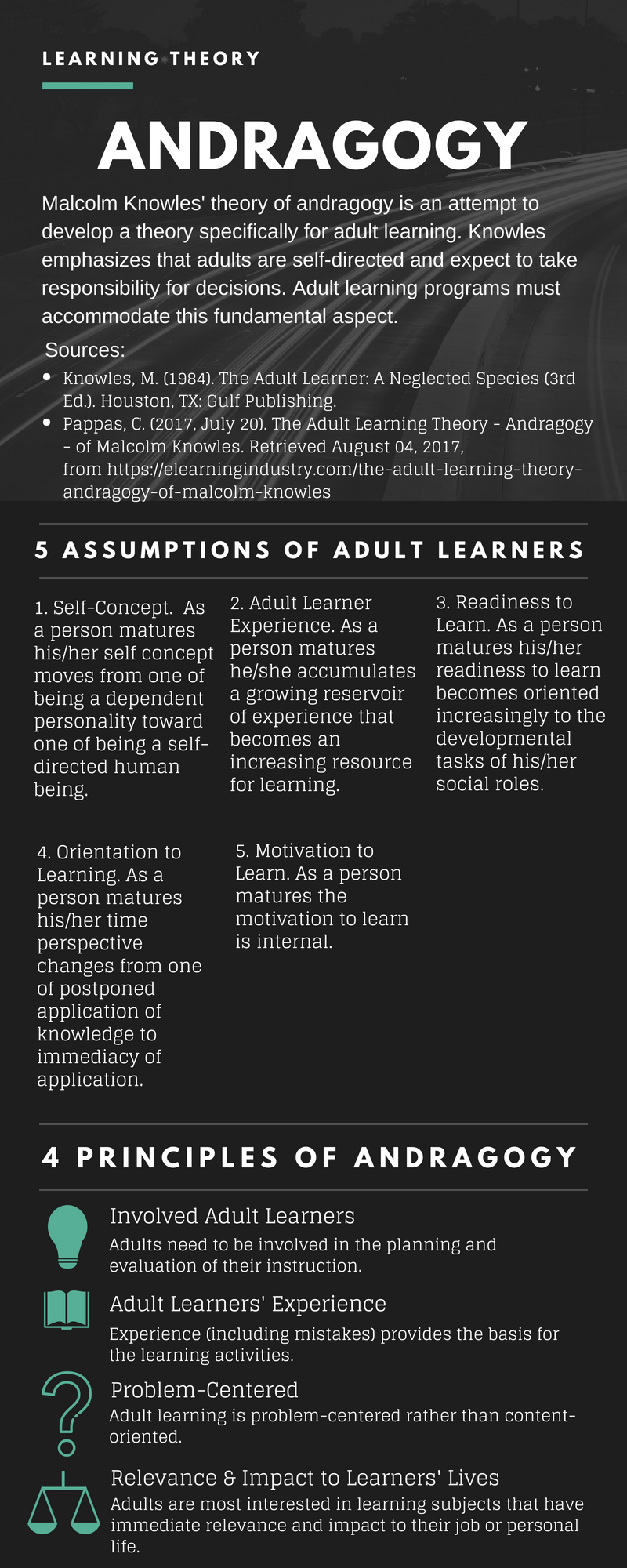
Malcolm Shepherd Knowles (1913 – 1997) was an American educator well known for the use of the term Andragogy as synonymous to adult education. According to Malcolm Knowles, andragogy is the art and science of adult learning, thus andragogy refers to any form of adult learning. (Kearsley, 2010).
The term andragogy can be supposedly equivalent to the term pedagogy. Andragogy in Greek means man-leading in comparison to pedagogy, which in Greek means child-leading. However, it should be noted that the term pedagogy has been used since the Ancient Greek times, while Alexander Kapp, a German educator, first used the term andragogy in 1833.
Application of Andragogy in Personal Computer Training
Knowles (1984) provides an example of applying andragogy principles to the design of personal computer training:
- There is a need to explain the reasons specific things are being taught (e.g., certain commands, functions, operations, etc.)
- Instruction should be task-oriented instead of promoting memorization — learning activities should be in the context of common tasks to be performed by the others.
- Instruction should take into account the wide range of different backgrounds of learners; learning materials and activities should allow for different levels/types of previous experience with computers.
- Since adults are self-directed, instruction should allow learners to discover things and knowledge for themselves without depending on people. However, learners should be offered guidance and help when mistakes are made.
 Cynthia Proctor